JeepParts
My Garage
My Account
Cart
OEM 2004 Chrysler Pacifica Parking Brake Cable
Emergency Parking Brake Release Cable- Select Vehicle by Model
- Select Vehicle by VIN
Select Vehicle by Model
orMake
Model
Year
Select Vehicle by VIN
For the most accurate results, select vehicle by your VIN (Vehicle Identification Number).
2 Parking Brake Cables found


2004 Chrysler Pacifica Front Cable Part Number: 4683912AC
Product Specifications- Other Name: Cable - Parking Brake; Brake Cable; Cable Parking Brake
- Item Weight: 2.40 Pounds
- Item Dimensions: 15.8 x 13.3 x 1.3 inches
- Condition: New
- Fitment Type: Direct Replacement
- SKU: 4683912AC
- Warranty: This genuine part is guaranteed by Mopar's factory warranty.
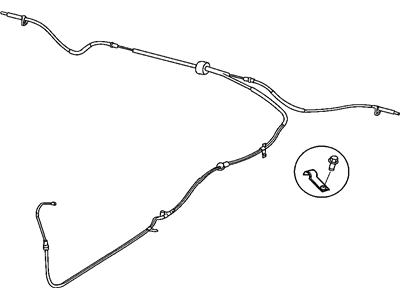
2004 Chrysler Pacifica Rear Cable Part Number: 4683858AC
Product Specifications- Other Name: Cable - Parking Brake; Brake Cable; Cable Parking Brake
- Item Weight: 1.00 Pounds
- Item Dimensions: 31.3 x 1.2 x 0.5 inches
- Condition: New
- Fitment Type: Direct Replacement
- SKU: 4683858AC
- Warranty: This genuine part is guaranteed by Mopar's factory warranty.
2004 Chrysler Pacifica Parking Brake Cable Parts and Q&A
- Q: How to Service and Repair a Parking Brake Cable on 2004 Chrysler Pacifica?A: It is important to first disconnect the negative cable from the battery post, isolate it and lock the adjuster on the parking brake lever before doing any service or repair. Elevate the vehicle and if you find it tight, adjust the rear brake shoes to get enough room for the cable buttons to be disconnected from their connectors. Press in the left rear button and remove the cable from the equalizer, then connect the end of the front cable to the cable connector with your pliers as the right rear button slides inboard and out of its connector. Pull the equalizer off its rack on the front of the car, then take it out and unscrew the cable guide securing the front parking brake cable to the left body rail. Once the vehicle is in drive, bring the truck down and roll it off the hoist to reveal the left side doors. Remove the scuff plates on the door sides, then the weather strips, below the cowl and the bolt that holds the seat belt at the B-pillar, on the left side. Get rid of the left B-pillar trim panel and the cable routing clips on the studs under the left side carpet. Take out the grommet in the floor, slide the cable up to the car, separate the release rod and wiring connector near the parking brake lever and indicator lamp switch. First, take out the body control module, then the three mounting nuts and finally the two wiring routing clips to remove the body control module mounting bracket. Detach the parking brake lever from the cowl by removing the bolts and the nut, placing it on the driver's floor and observing how the cable is routed through the lever to remember it for reassembly. Remove the front cable button from the lever take-up reel and slide the cable all the way down into the housing until you feel the cable button touch the housing. With a 13 mm box wrench, collapse the retainer fingers on the cable housing end and remove the parking brake cable from its lever. To install, place the end of the cable you're holding into the hole in the top lever, then secure it by pressing the cable retainer into its place. Take the cable button on the end of the strand out of the housing and run the cable strand up the lever cam over to the take-up reel, after which you insert the front cable button into the lever take-up reel. Hold the bicycle upside down and insert any remaining cable back into the housing. Put the lever against the left lower cowl and screw in the two mounting bolts and one nut, ensuring all are tightened to 28 Nm (21 ft. lbs.). Put the body control module mounting bracket in place by screwing it on with the three included mounting nuts and two wiring routing clips and tighten all securing bolts by turning them to 14 Nm (125 inch lbs.) torque. Connect the cable at the parking brake indicator lamp with the cable at the parking brake release rod on the lever. Guide the front cable to the left side area under the carpet, tunnel the other part of the front cable through the hole in the floor pan and kick in the clips to hold the cables above the studs on the left side floor pan. Fit the cable grommet in the floor pan, put the carpet back in place and set the left B-pillar trim and bolt for the left front seat belt on the B-pillar. Put on the lower cowl trim, left front and left rear door weather strips and left front and left rear door opening sill scuff plates. With the vehicle lifted, slot the cable through the underbody and join the front cable to the left body rail, using a 17 Nm/150 inch lbs. torque to secure it. Along the inner cable line, put the equalizer onto the front cable, then route the cable as it goes past the left rear brake tubing and the rear driveline module (on cars with AWD). With your pliers holding the button of the front cable, link the rear cable button and connector together, then let the cables go so the button can find its place in both cables. Insert the left rear parking brake cable into the equalizer and release both cables so that the button seats. If the cable does not seat on its own, apply hand pressure. Bring the vehicle down, open the automatic adjuster in the parking brake lever and link the battery's negative terminal to its post after you start the process.
Related 2004 Chrysler Pacifica Parts
 2004 Chrysler Pacifica Brake Booster
 2004 Chrysler Pacifica Speed Sensor
 2004 Chrysler Pacifica ABS Control Module
 2004 Chrysler Pacifica Brake Caliper
 2004 Chrysler Pacifica Brake Caliper Bracket
 2004 Chrysler Pacifica Brake Caliper Piston
 2004 Chrysler Pacifica Brake Disc
 2004 Chrysler Pacifica Brake Line
 2004 Chrysler Pacifica Brake Master Cylinder
 2004 Chrysler Pacifica Brake Pad
 2004 Chrysler Pacifica Parking Brake Shoe
 2004 Chrysler Pacifica Wheel Stud